







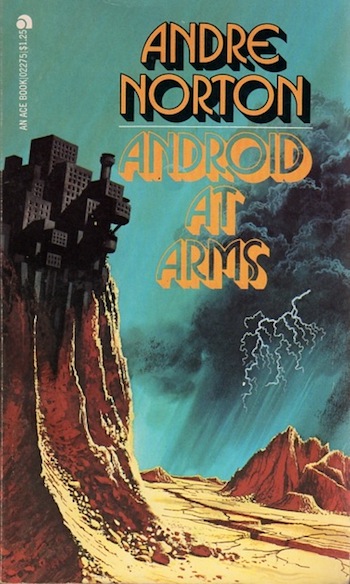
This book did not go where I expected it to go at all. The title, to start with: I expected something like Forever War meets I, Robot. Protagonist finds himself kidnapped and hauled off into space to fight. I just read a Norton novel that did exactly that, Secret of the Lost Race.
For a fair few chapters I kept expecting this to happen. Planetary prince Andas expects to be chosen as the Emperor’s heir, but wakes up on an alien world with an assortment of other, more or less equally royal, noble, or politically powerful people. Or are they people? There’s been an interplanetary conspiracy to replace influential personages with android doubles.
So then the question becomes, Is Andas the original or an android? What has happened on his own world, if he hasn’t been there to take the throne? The other question that might have interested me, What about the people who did this in the first place?, doesn’t really get answered and doesn’t seem to concern Norton overly much.
Almost immediately after Andas comes to and gets to know some of his fellow prisoners or doubles or whatever they are, a massive power failure takes down the prison’s defenses and lets them escape. They’re in the middle of a wasteland, but they manage to liberate a transport with just enough capacity for the handful of escapees.
This handful drops down fairly quickly to just six, five humans (more or less) including Andas, and one catlike Salariki named Yolyos. By this time they’ve managed to capture a spaceship and rig it to get them offworld—after drawing lots as to which of the navigation tapes to plug in. The one to Andas’ world wins.
But! Not so fast! One of the escapees is a major player in the Thieves’ Guild, and he’s conspired with some of the others to swap the tapes. The ship lands on a Guild outpost, but it’s in ruins. It’s been decades since any of them was kidnapped. Nobody really knows how many, or why, or how, and again, it doesn’t really matter.
What matters is that Andas, Yolyos, and two of the humans manage to get away and plug in the real tape, and finally land on Andas’ planet, Inyanga. But the plot has only just begun to twist. Not only have forty-five years passed, another Andas is now Emperor, and his daughter is a devotee of an ancient and horrible, female-presenting evil.
The other two humans, the nasty fat one named Grasty and the excessively girly, conspicuously helpless, manipulative fish-girl Elys, betray Andas and ally themselves with his enemies. Andas manages to liberate the key to the Emperor’s ancient and secret weapon, and he and Yolyos escape through a portal into an alternate reality.
As I said, the twists keep coming. Andas’ plan is to hide out until he can re-emerge and use the key to claim his rightful throne, but since no one has ever returned alive through the portal, that seems a little optimistic.
Sure enough, he’s called through the portal by someone on the other side, the rebel and refugee Shara—and Shara’s lord and Chosen partner, the badly wounded and dying alternate-Andas. This Andas is the head of a dying resistance, fighting the devotee of the evil female-presenting power, who in this reality has seized the throne. He manages to persuade our Andas to take his place and his cause, before he dies and Andas swears the oath that makes him, for all useful purposes, Emperor.
Now Andas is bound to save this world from evil. Which, with Yolyos as his loyal sidekick and Shara as his guide and protector, he proceeds to do. This includes an adventure with night-crawling horrors controlled by machines manufactured by, more or less, magic, a truce with a company of offworld mercenaries, a quest into a Chernobyl-like (if Norton had only known what would happen fifteen years after this novel was published) radiation sink, and a final (or so he thinks) sacrifice that destroys the evil and—in one last twist—saves Andas.
Which makes him think he must be an android after all, or why didn’t the radiation kill him? Because, says Yolyos, who plays the role of Wise Sidekick, the ancient weapon he liberated from the radiation sink canceled out the radiation and healed him and now he gets to rule with Shara and not even stop to think about going back to his own reality. And yes, he’s human; the medics checked him out, and he’s not a machine.
That still doesn’t explain how middle-aged false-Andas, if he is an android, managed to produce three daughters, unless androids are really some form of clone. But that doesn’t matter. It’s all about the adventure, in the end.
The first half of this novel had me grouching a lot about its gender roles. Women are either evil sorceresses, evil girly-girls, or dead. And let’s not even talk about the fat-prejudice.
The latter is A Problem, and not one that’s resolved. But the former transforms once Andas meets Shara. She’s skinny, filthy, unattractive, and awesome. Andas grows into that realization, in so many words. He’s had zero experience of women in his life, all he’s ever known of them is a set of stereotypes, and it dawns on him gradually that Shara is amazing. Not only that, she’s at least his equal.
Norton, in short, gives us the stages of a feminist awakening. Especially after reading a series of novels from the Fifties, with their all-male universes and their unexamined gender stereotypes, I really appreciate what she did there. It’s like a direct response to all of my commentary through this series, addressing a whole range of problematical depictions of women in her early novels. She knew. She thought about it. And she did something about it.
There’s something else, too. Her early novels are pretty much not there when it comes to characters’ inner lives. But Andas, here at the dawn of the Seventies, stops to think about who and what he is, what he knows and assumes, and what it all means. It’s not what I’d call great characterization; it doesn’t go very deep. But for Norton it’s significant.
She’s going there with diversity, too; not terribly successfully in the sense of 2019, but for 1971 it’s really not bad. Andas and his fellow Inyangans are part of the African diaspora from Terra, and their culture tries hard to reflect this. There are white people here and there but they’re not central to the story. The center is brown and black people, and they’re written as accurately as, at the time, she knew how.
Next up: Wraiths of Time.
Judith Tarr’s first novel, The Isle of Glass, appeared in 1985. Her most recent novel, Dragons in the Earth, a contemporary fantasy set in Arizona, was published by Book View Cafe. In between, she’s written historicals and historical fantasies and epic fantasies and space operas, some of which have been published as ebooks from Book View Café and Canelo Press. She has won the Crawford Award, and been a finalist for the World Fantasy Award and the Locus Award. She lives in Arizona with an assortment of cats, a blue-eyed dog, and a herd of Lipizzan horses.
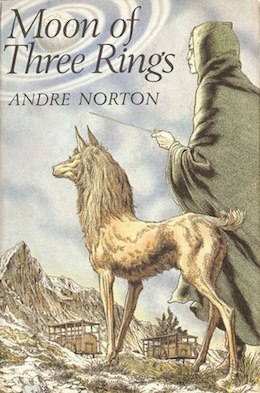
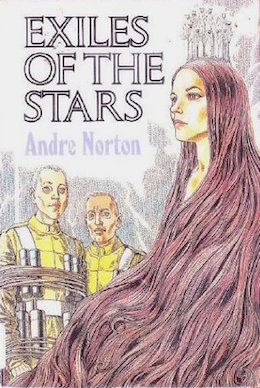
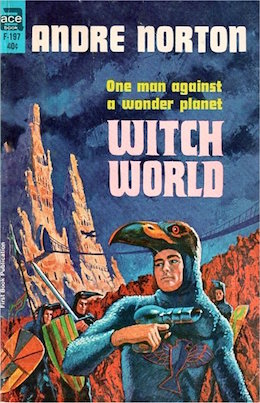

One of the first Norton novels I found in the library at Leona Doss Elementary School in 1971 Austin. I re-read it in the 1990s and liked it just as much. Maybe another round is due.
If anyone is looking to find this novel, it and TIME WRAITHS were printed together as GODS AND ANDROIDS.
Norton always goes in a totally different direction than expected. Boy wants his throne back so he fights for it. Nope, alternate worlds and possibilities. Then yet another shift in the narratives. Weird, but it works for her.
This one always felt a bit as if Norton kept writing herself into a corner and then jumping into a new story with the same characters. Although, I have to say, I really liked this one and have read it more than once.
The Psychocrats remain an interesting bit of Norton’s world-building. I’ve never come across a story set while they were a ruling force, just ones dealing with their aftermath. Andas suspects a surviving group of Psychocrats kidnapped him and the others and replaced them.
As rulers, the Psychocrats were evil tyrants. They did things like mind-wipe entire populations and implant whatever false memories they felt like. A Psychocrat who liked Game of Thrones might create a colony where everyone believed they were the the kingdoms in the books and toss in “magic” crowns that controlled the minds of everyone in the kingdom to keep them on script. However, as people, they were simply amoral. They didn’t blink twice about doing horrible things, but we can’t assume their intents or actions in particular situation were evil.
So, they might have had evil intentions for whatever they were doing with Andas and the others or they might not. Here are the scenarios as I see them:
1) Andas and the others are the originals, kidnapped in kept in a kind of stasis in case the Psychocrats needed the originals at any point. This was probably part of a plan by surviving Psychocrats to create discord and instability. They replaced what seemed to be good, effective leaders with bad and/or evil ones. The crime lord, for example, seems to have been replaced with one who got his people wiped out. Andas was replaced by a leader who has let all sorts of evil take root in the government.
2) The Psychocrats were creating doubles of evil or weak leaders who were the opposite of the originals, effective rulers and good leaders. But, something went wrong. Although leaders were still being copied and given their improved programming or memories, the system to make the replacements was never implemented and the copies were kept in stasis.
3) The doubles were recently created, possibly as part of an ongoing plan, possibly as part of a plan that was still in the starting phase. The power failure that allowed the doubles to escape was probably unplanned. It seems unlikely a group of hidden Psychocrats would tip their hand so obviously as letting loose a bunch of modified doubles. On the other hand, if they were confident in their ability to remain hidden, they’re creating a lot of instability. People who might not have rebelled against “bad” Andas might change their minds if a “good” Andas appeared and made it clear that “bad” Andas was an imposter under the control of the worst boogeymen this universe has. They could also trigger witch hunts as people hunt for hidden Psychocrats. If the hidden Psychocrats were reasonably sure the people who were going to get caught and killed wouldn’t be real Psychocrats, that’s all to the good from their POV.
Of course, we never find out which, if any of these, might be the truth. That’s the one part that still drives me nuts.
Speaking of the Psychocrats, they were also mentioned in Ice Crown where they’d created a horrific sociological experiment on an entire planet population. Since they were the rulers of the Confederation region of space, I suspect they were in power during the Xik war in The Beast Master books and may have lied about the destruction of Earth to galvanize humans to win the war because in other novels set later like Catseye, Breed to Come, Space Rangers… Earth has recovered and obviously wasn’t burned to a cinder.
I got hopelessly lost just reading the synopsis!
@@.-@ Looks as if I’d better read Ice Crown after Wraiths of Time. I thought I had done it already, but that was a title confusion. The one I read was Horn Crown.
Your suggestions are always invaluable. Thank you. :)
Wow thanks! I’ve really been enjoying the heck out of your reviews. I think you’ll find Ice Crown and it’s protagonist quite interesting (and very different from Horn Crown). ;)
I think we’re all on the same page. This book is all over the place! But… it’s super fun to read!
In a way, it’s a great thing that the mystery is left unsolved. It keeps you guessing…
But add that the last couple of pages seemed rushed and convenient. An extra chapter or two elaborating how Andas survived would have been welcomed.